An Example to Servicemen
In 1945, with the major leagues emptied by the draft, the St. Louis Browns brought up a one-armed outfielder. The sportswriters called Pete Gray an example to wounded servicemen, a gate attraction worth touring, a one-armed star. Across roughly two dozen pages in sixteen papers, over two seasons, Gray himself speaks once — two words, to a child.
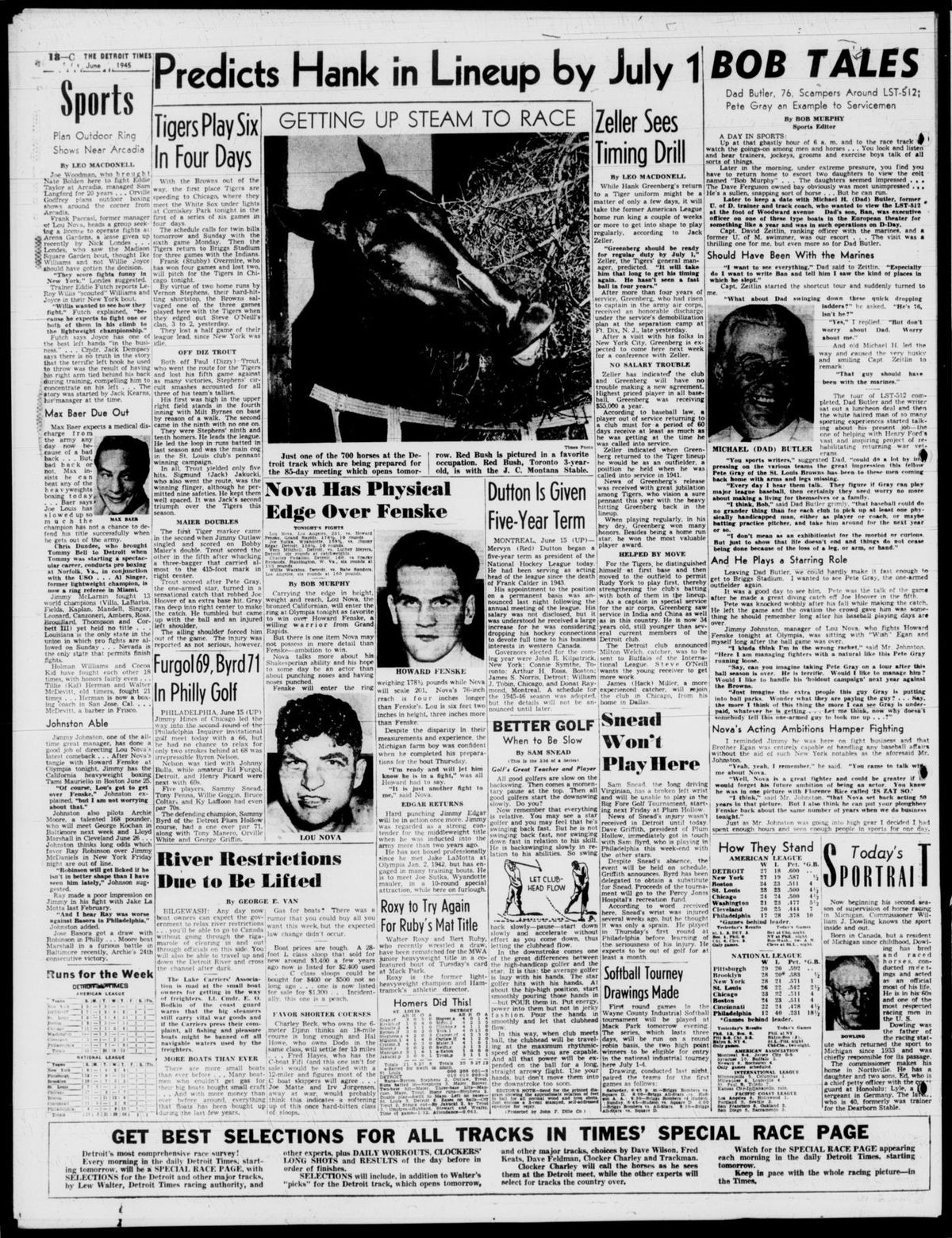
View the original at the Library of Congress →
In January 1942, weeks after Pearl Harbor, President Roosevelt wrote the commissioner of baseball a short letter. “I honestly feel,” he told Judge Kenesaw Mountain Landis, “that it would be best for the country to keep baseball going.” The players would go to war, and the rosters would empty year by year, but the game would not stop.
By 1944 the drain was on the sports page in plain sight. Two National Football League teams, the Chicago Cardinals and the Pittsburgh Steelers, had merged for the season into a single club, and the papers carried its losses as a matter of course — the scoreboard even in the Daily Alaska Empire, in Juneau, read “Chicago Bears 34, Card-Pitt 7.” The major leagues filled in with the too-old, the too-young, and the 4-F. Into the 1945 season came a thirty-year-old outfielder named Pete Gray, up from Memphis, where he had hit .333.
Passes test at bat
Pete Gray had one arm. He had lost the right one as a boy — the papers that told his story got the particulars a little wrong; the Waterbury Democrat said it was “an auto accident when he was five and a half,” when the record is a produce truck, and he was six — but they agreed on the rest: the arm was gone above the elbow, and Gray had taught himself to play the game anyway. At Memphis in 1944 he had been the most valuable player in the Southern Association.
The Browns brought him up for 1945. They were, that spring, the reigning champions of the American League — they had won the pennant in 1944 for the first time in their forty-three-year history, and St. Louis had been so pleased that the mayor proclaimed a “St. Louis Baseball Week.” Gray made his debut on April 17, the home opener. “Pete Gray Passes Test at Bat, On Bases,” the Detroit Evening Times reported the next day: at bat four times, he was credited with a single. An Army airfield paper in Connecticut explained to the servicemen who read it exactly how he did it — “His method for throwing requires him to remove his glove, tuck it under the stub of his right arm and heave, all in one motion.”
An example to servicemen
In a June game against Detroit, Gray — “the one-armed star,” the paper called him — ran deep into right-center and made a diving catch that robbed Joe Hoover of an extra-base hit, tumbling and coming up with the ball and a shoulder hurt badly enough to take him out of the game. It was the kind of play that ends up in a column, and it did. But the column it ended up in was not really about the catch.
The Detroit sportswriter Bob Murphy had spent that day with a seventy-six-year-old trainer named Dad Butler, who was helping to rehabilitate wounded veterans, and Butler had a proposal. Sportswriters, he said, could do a lot by pressing on the teams “the great impression this fellow Pete Gray of the St. Louis Browns has been to these men coming back home with arms and legs missing.” Every club should sign a handicapped man, Butler said — and then he named the trap himself: “I don’t mean as an exhibitionist for the morbid or curious. But just to show that life doesn’t end and things do not cease being done because of the loss of a leg, or arm, or hand.”
A few inches down the same column, a boxing manager named Jimmy Johnston did mean it that way. Watching Gray, he thought out loud about taking him on tour: “Just imagine the extra people this guy Gray is putting into ball parks. Wonder what they are paying the guy?” Gray was underpaid, Johnston figured, and somebody ought to “tell this one-armed guy to look me up.”
The Army made him a lesson too. Under the headline “Baseball An Inspiration,” the Bradley Beam — an airfield weekly whose every column was reviewed by the base public-relations office — paired Gray with Lieutenant Bert Shepard, an Air Forces pilot who had lost a leg when his plane was shot down over Germany, and told its readers that “Shepard and Gray should be an inspiration to the thousands of soldiers who have been wounded in action.” One of the two men had been to war.
All of this ran on ordinary sports pages, in the middle of an ordinary wartime paper — between the box scores and the boxing cards and the notices for the seven-hundred horses being readied for the local track, beside the returning ballplayers just out of the service and the advertisements that were themselves the home front, motor oil to “Keep Your Car In Condition” and house paint to be paid off in eighteen months.
Big league pitching is just too much
By October the sportswriters had decided about him. “Will Pete Gray Go To Minors?” the Toledo Union Journal asked. “Some baseball fans are of the opinion that Pete Gray, the one-armed outfielder of the St. Louis Browns, is through in major league baseball. It is said that big league pitching is just too much.” He had batted .218 in seventy-seven games. He was, in the end, exactly the thing the men who wrote about him kept insisting he was more than. He was a ballplayer they decided couldn’t hit.
There is, in all of it, one place where Pete Gray speaks.
In September 1944, while he was still at Memphis, a three-year-old boy named Nelson Gray Jr. — no relation — was brought from Los Angeles to meet him. The boy had one arm too; he had lost it, not yet three, in a home mangle. He worshipped Gray, could recite his batting average, wanted a Memphis uniform “just like Pete’s.” A newspaper fund paid his way. They met on the field.
“Hello, youngster,” smiled Memphis Outfielder Pete Gray.
They shook hands — with their lefts.
Across two seasons and roughly two dozen pages, everyone else says what Pete Gray was for — an example, an attraction, an inspiration, a star. Gray himself says two words, to a boy who was like him, and goes back to the dugout.
The scan shown is the sports page of the Detroit Evening Times of June 16, 1945 — the catch, and the column, on one sheet; it is self-hosted, and the link points to the original in the Library of Congress’s Chronicling America collection, where it is public domain. Pete Gray’s play, the framing quoted here, and his single line of speech are drawn from that page and from the Detroit Evening Times of April 19, The Bradley Beam (Bradley Field, Conn.) of May 5, The Wilmington Morning Star of October 3, 1944, The Daily Alaska Empire of October 16, 1944, The Toledo Union Journal of October 19, 1945, The Waterbury Democrat of June 27, 1945, and the Springfield Weekly Republican of September 21, 1944 (an Associated Press feature) — all public-domain and digitized in Chronicling America. Period language — “one-armed star,” “handicapped idol,” “an example to servicemen” — is quoted as those papers printed it and is not the language of this publication. The Bradley Beam is a U.S. Army base paper; the “Baseball An Inspiration” editorial carries no syndicate credit and is a government work in the public domain. President Roosevelt’s “green light” letter to Judge Landis (January 15, 1942) is quoted from the National Archives’ account; the original is held at the National Baseball Hall of Fame, a carbon at the Roosevelt Library. The accident that cost Gray his arm was reported inconsistently in the papers of the day; the corrected detail (a produce truck, at age six) and his 1944 (.333, Southern Association MVP) and 1945 (.218 in 77 games) batting records are from the Society for American Baseball Research’s biography, cited here for those facts and kept distinct from the newspaper record. Nelson Gray Jr. is named as the papers named him.
“An Example to Servicemen,” Detroit Evening Times, June 16, 1945, p. 18. Library of Congress, Chronicling America. loc.gov/resource/sn88063294/1945-06-16/ed-1/?sp=18